
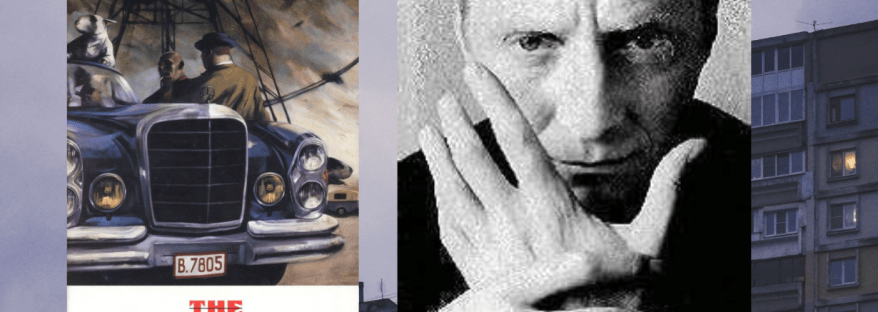
Why, oh why did I decide to read this short story alone at night? Of all Carroll’s frightening and thought-provoking stories in The Panic Hand, “Tired Angel” is the worst story to read when you hear a bump in the night. And that makes it my favorite story in this collection.
TRIGGER WARNING: Mentions/descriptions of stalking, harassment, and suicide.
For such a short read, “Tired Angel” leaves an impressive impact on a reader through the clever use of first-person narration. Our POV character, the Tired Angel, describes how he stalked and harassed a woman just for a laugh. If that isn’t disturbing enough, the structure of this story is a letter addressed to the reader, using the second-person “you” as a way to instill discomfort and anxiety through a casually conversational tone. A handwritten letter can be an informal and intimate method of communication.
The story begins with the second-person “you” right off the bat: “You don’t know me, but you will—soon” (Carroll 178). Already, the ominous tone is established. What’s more, the simple word “soon” frames the story perfectly, as it appears at the very end in the signature to create a sense of unnerving symmetry: “Soon, Your Tired Angel” (Carroll 183).
The narrator continues, giving a description of what he imagines the reader to be like:
Give me an hour to introduce myself if you would. Less, if you’re a fast reader. I imagine you’re a fast reader. You read fast because you’re a no-nonsense woman. Get up to change channels manually on the television (despite having a little gizmo box to do it for you), know where your scissors are, as well as everything else in your desk. Fresh underwear every morning. Let me guess—white? With perhaps a pair of expensive black sexy ones in a drawer for special occasions? Am I right? I bet I am.
Carroll, 178
The narrator makes several assumptions, some of which could be true while others miss the mark. He says I, the reader, am in fact a woman (I am) and a fast reader (I am). While not all of these descriptors hit the mark, a couple of them do. And even if none of them were correct, the narrator still comes off as creepy by mentioning the reader’s underwear. The ending two sentences of this passage (“Am I right? I bet I am.”) calls attention to the Tired Angel’s arrogance.
When the Tired Angel starts dating his stalking victim, his conversational tone and smugness show up again. After sleeping with his victim, he writes:
“Borrrrrrring. Who would have thought that someone who loved to be naked would turn out to be so dull in bed?”
Carroll, 189
As a reader, I can all but hear the Tired Angel’s drawl, “Borrrrrrring.” His callous remark about being underwhelmed by his girlfriend/victim’s sexual abilities is enough to make me hate him even even more. His off-hand remarks highlight his cruelty toward his victim.
After a long period of harassing phone calls, the Tired Angel goes one step further.
“What I would have done next, I have no idea, because one night in April I called, watched her walk by the telephone and jump out the window. Zoom! What a surprise.”
Carroll, 182
If the childish interjection (“Zoom!”) isn’t enough to highlight the amusement the Tired Angel gets from this new development, his little add-on, “What a surprise,” implies that the result of his harassment was an unexpected treat.
But it was the very last paragraph and signature that sent chills through my bones:
“Not much more to tell you. Here’s a hint—maybe I’m someone you already know. Maybe not. Maybe I’m looking at you right now. Have you ever thought about how many people look at you that you don’t even see in a lifetime? Soon, Your Tired Angel.”
Carroll, 183
The Tired Angel brings the focus back to the reader, framing the story perfectly. He plays with the reader’s mind, saying he might be someone we know (or not) and making us think twice about the people we’re close to. The line, “Have you ever thought about how many people look at you,” is especially chilling. I can all but feel the eyes staring at me from beyond the window.
Honestly, I get chills rereading this last paragraph. Once again, I’m amazed at how one little word, “soon,” can still so much dread in a reader, with the right amount of context and a perfectly terrifying conversational tone.

 Rachel Sandell